
How to Sleep Better During Daylight Saving Time | NuCalm
How to Sleep Better During Daylight Saving Time: A Science-Backed Reset Plan
Every spring, 1.6 billion people in over 70 countries lose one hour of sleep overnight. That single lost hour triggers a cascade your body wasn’t built to handle: spiked cortisol, disrupted melatonin, fragmented deep sleep, and a circadian rhythm scrambling to catch up. The result is what most people dismiss as “just being tired”, but the science tells a more serious story.
Research published in Current Biology found that the human circadian clock adjusts to spring forward at a rate of roughly 10 minutes per day, meaning full recovery can take up to a week. During that window, your cognitive performance, immune function, cardiovascular health, and mood are all measurably compromised.
NuCalm was built for exactly this. With 35+ years of patented neuroscience behind it, NuCalm directly targets your autonomic nervous system, the very system that regulates sleep, stress, and recovery, to help you transition through the time change faster, sleep deeper, and wake up feeling like yourself again.
What Does Daylight Saving Time Actually Do to Your Body?
Your circadian rhythm is a finely tuned biological clock synchronized primarily to light exposure. When daylight saving time shifts the clock by an hour, your internal clock doesn’t follow, at least not right away. This misalignment between external time and internal biology is called circadian desynchrony, and its effects are well-documented:
- Cortisol spikes : Sleep disruption activates your HPA axis (hypothalamic-pituitary-adrenal), flooding your system with cortisol, the primary stress hormone. Elevated cortisol suppresses melatonin, making it harder to fall asleep the following night.
- Reduced deep sleep : Even minor circadian disruption reduces time spent in slow-wave (deep) sleep — the stage responsible for physical recovery, immune function, and memory consolidation.
- Increased cardiovascular risk : A 2014 study in Open Heart found a 24% increase in heart attacks on the Monday after spring forward.
- Cognitive impairment : Reaction time, attention, and executive function all take measurable hits after a single hour of lost sleep.
- Weakened immune response: Sleep is your immune system’s primary restoration window. One disrupted night is enough to reduce natural killer cell activity by up to 70%, according to research from UC Berkeley.
How NuCalm Resets Your Sleep After Daylight Saving Time
Most sleep advice centers on habits: keep a consistent bedtime, avoid screens, dim your lights. That’s all valid, but habits take weeks to shift. NuCalm works differently. It uses neuroacoustic technology, clinically validated to guide your brain from an alert Beta state down through Alpha, into Theta, and ultimately into deep restorative states, without drugs, without willpower, and in as little as 20 minutes.
Here’s how each NuCalm program serves a specific role in your DST recovery:
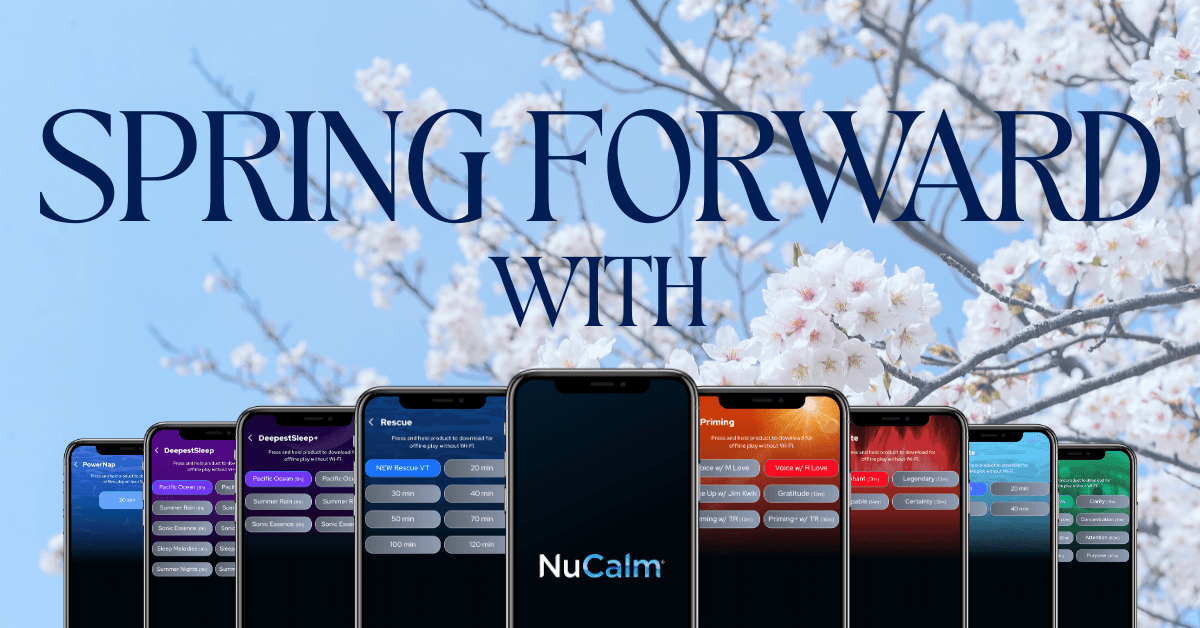
DeepestSleep / DeepestSleep+: Rebuild Your Circadian Foundation
Your body’s transition into deep sleep depends on a steep cortisol decline in the evening. When DST disrupts that curve, NuCalm’s DeepestSleep and DeepestSleep+ programs step in to do what your nervous system is struggling to do on its own: lower sympathetic activation, suppress cortisol, and guide brainwave activity into the Delta range (0.5–4 Hz) where true restoration happens.
How to Use DeepestSleep & DeepestSleep+
Best used: every night at bedtime, starting 3–4 days before the clock change.
Pro tip: Beginning your DeepestSleep routine before DST “teaches” your nervous system the new sleep schedule before your body has a chance to fall out of rhythm.
Rescue: Your Daytime Recovery Tool
When you’re running on compromised sleep, caffeine masks fatigue without resolving it. NuCalm Rescue delivers the neurological equivalent of 2 of restorative sleep in a single 20-minute session by rapidly downregulating your sympathetic nervous system and stimulating parasympathetic recovery.
Best used: Anytime, but specifically early afternoon (1–3 PM), before the cortisol crash hits.
Pro tip: Rescue is not a nap, you won’t wake up groggy. It’s a targeted nervous system reset that restores mental clarity and energy without disrupting your nighttime sleep.
Focus: Train Your Brain for the New Schedule
Morning cognitive function is one of the first casualties of a disrupted sleep cycle. NuCalm Focus trains your brain into an alert, sustained Beta state. Focus specifically takes you to 18.4Hz, the frequency associated with the learning zone and peak cognitive performance, helping you show up fully for the day even when your body is still adjusting.
Best used: Anytime. For DST, Focus is recommended to be used in the morning, paired with 10–15 minutes of natural light exposure within 30 minutes of waking.
Your 4-Day Daylight Saving Time Recovery Plan
This protocol is designed to minimize adjustment time and protect your sleep quality through the entire transition window.
| Day | NuCalm Action | Why It Works |
| Night Before DST | DeepestSleep every night | Suppresses cortisol and begins realigning your sleep-wake signal before the shift happens. |
| Day of Spring Forward | Morning light + Focus session. Rescue session early afternoon. | Light exposure resets your suprachiasmatic nucleus (your brain’s master clock). Focus keeps cognition sharp. Rescue prevents the afternoon crash. |
| Day 2 | Continue DeepestSleep at night. Rescue midday. | Consistency reinforces the new rhythm. Your HPA axis begins recalibrating. |
| Day 3 - 4 | DeepestSleep nightly. Rescue every day. | By day 4, most people are fully adjusted. Your body has internalized the new schedule. Continue using DeepestSleep every night and Rescue every day for cumulative benefits. |
Why NuCalm Works When Nothing Else Does
Most sleep interventions address symptoms; melatonin supplements, sleep masks, white noise machines. NuCalm works at a deeper level: your autonomic nervous system.
Your autonomic nervous system has two branches: the sympathetic (fight-or-flight) and parasympathetic (rest-and-digest). Sleep only happens when the parasympathetic branch is dominant. When DST disrupts your schedule, it triggers a sympathetic response: your body treats the time shift like a mild stressor, keeping you alert when you should be winding down.
NuCalm’s neuroacoustic technology directly activates the parasympathetic branch by delivering precisely calibrated audio frequencies that entrain your brain into the specific wavelengths associated with deep rest. It doesn’t sedate you, it removes the neurological barrier to recovery.
This is why NuCalm has been used by the US military, professional sports teams, and leading healthcare organizations. It’s not a wellness trend, it’s applied neuroscience.
Frequently Asked Questions About Sleep and Daylight Saving Time
How long does it take to recover from daylight saving time?
Research suggests most people need between 5 and 7 days to fully recover from the spring forward time change. The circadian clock adjusts at approximately 10 minutes per day, meaning a full hour shift can take up to a week. People with already irregular sleep schedules may take longer. Using NuCalm’s DeepestSleep & Rescue protocol starting 3-4 days before the change can significantly reduce recovery time.
Why does spring forward feel worse than fall back?
Spring forward is harder because you’re losing sleep, not gaining it. The shift forces your body to fall asleep and wake up an hour earlier than your internal clock is set for, essentially mimicking mild jet lag traveling east. Fall back gives you an extra hour, which is less disruptive even if it temporarily extends your evening alertness.
What does daylight saving time do to your circadian rhythm?
Daylight saving time creates a mismatch between your internal biological clock and external social time. This circadian desynchrony disrupts the natural hormonal curves that regulate sleep: melatonin rises later, cortisol spikes earlier, and the deep sleep stages become shorter and less restorative until your system recalibrates.
Can NuCalm help with jet lag and time zone changes too?
Yes. NuCalm’s DeepestSleep and Rescue programs are used regularly by athletes, executives, and military personnel to recover from time zone shifts and irregular sleep schedules. The mechanism is the same as DST recovery: directly downregulating the sympathetic stress response and creating neurological conditions for deep, restorative sleep regardless of what the clock says.
Is NuCalm safe to use every night?
NuCalm is completely drug-free and safe for daily use. Unlike sleep medications, it doesn’t create dependency, suppress REM cycles, or cause next-day grogginess. Most regular users report improvements in baseline sleep quality over time, suggesting that consistent use strengthens rather than replaces your body’s natural sleep architecture.
What’s the best NuCalm program to use during daylight saving time?
For the spring forward transition, start with DeepestSleep the night before the change and continue for 4-5 nights. Add a Rescue session every day for better results. Use Focus in the morning paired with natural light exposure to anchor your body to the new schedule faster.
10 Things Most People Don’t Know About Daylight Saving Time
Before you set your clocks forward this spring, here’s the fascinating, frustrating, and occasionally absurd history of the practice disrupting your sleep tonight.
1. It was first proposed by an insect collector
In 1895, New Zealand entomologist George Hudson proposed a two-hour seasonal time shift so he’d have more daylight after work to collect bugs. His real motivation had nothing to do with energy savings.
2. Benjamin Franklin’s essay was satire
Franklin’s 1784 essay suggesting Parisians wake earlier to save candle wax was a joke. He never actually proposed changing the clocks, but the idea stuck to his legacy anyway.
3. Germany was first, as a wartime measure
Germany implemented DST in April 1916 to conserve coal during World War I. The US followed in 1918 for the same reason, then abolished it after the war until WWII brought it back.
4. Farmers fought against it
The common belief that DST helps farmers is backwards. Agricultural communities largely opposed it because their schedules are dictated by sunlight and livestock, not the clock. The farm lobby actively lobbied against it in the early 20th century.
5. Hawaii and most of Arizona don’t observe it
Both locations opted out due to already-abundant sunlight. The Navajo Nation within Arizona does observe DST, creating a patchwork of time zones within a single state.
6. Heart attack rates jump the Monday after spring forward
A study in Open Heart found a 24% increase in heart attacks on the Tuesday following spring forward. The combination of sleep deprivation and circadian stress creates measurable cardiovascular strain.
7. Car accident rates spike for days after the change
Sleep deprivation-induced inattention is responsible for a documented increase in traffic accidents in the week following spring forward. The effect is most pronounced on the first Monday after the change.
8. Russia tried permanent DST and reversed it
In 2011, Russia moved to year-round daylight saving time. The dark winter mornings were so widely unpopular, and associated with increased winter depression and morning accidents, that the country switched to permanent standard time in 2014.
9. Candy companies lobbied to extend it
When the US extended DST in 2005–2007, the candy industry lobbied specifically to include Halloween; more evening daylight means more trick-or-treating time, and more candy sold.
10. There’s a serious scientific movement to abolish it
The American Academy of Sleep Medicine, the Society for Research on Biological Rhythms, and multiple European scientific bodies have formally called for the elimination of DST in favor of permanent standard time. Their argument: permanent standard time is more aligned with human biology.
Don’t Let DST Set You Back
Daylight saving time is coming whether your nervous system is ready or not. But your recovery doesn’t have to take a week of groggy mornings, afternoon crashes, and compromised focus.
NuCalm gives you the tools to stay ahead of the disruption: reset your circadian rhythm before it breaks, recover faster on the days it does, and protect the sleep quality your body depends on year-round.
Start your 7-day free trial before the clocks change. Wake up on the other side feeling like you never lost an hour.