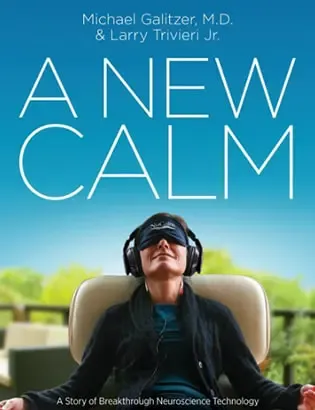
A New Calm: A Story of Breakthrough Neuroscience Technology
A 2016 book by Michael Galitzer, M.D., and Larry Trivieri Jr. about the patented technology behind NuCalm. It covers how Dr. G. Blake Holloway invented it and how it is used to reduce stress and improve performance.
- Document
- Book
- Authors
- Michael Galitzer, M.D. · Larry Trivieri Jr.
- Date
- September 1, 2016
Key findings
- 184 pages across six chapters, a foreword, a preface, an introduction, a glossary and 15 pages of source notes.
- Chapter 3 is the first-hand account of how Dr. G. Blake Holloway assembled the four components, drawn from his work in addiction treatment and brain wave biofeedback.
- Chapter 4 explains each of the four components in turn: neuroacoustics and binaural beats, cranial electrotherapy stimulation, the supplements or cream, and light blocking.
- Chapter 5 works through the applications one condition at a time, from the inflammatory cascade to cancer, heart disease, sleep disorders and jet lag.
Michael Galitzer, M.D., an integrative physician in Los Angeles, and the health writer Larry Trivieri Jr. wrote A New Calm in 2016 to explain where NuCalm came from and why it works. They had already written Outstanding Health together. Tony Robbins wrote the foreword and Brother Craig Marshall, a monk for 35 years, the preface. The book is dedicated to Dr. G. Blake Holloway, who invented the technology.
What follows is a chapter-by-chapter guide. All 184 pages are in the PDF, linked at the top and bottom of this page.
How the book came about
The idea came from Dr. Galitzer’s wife, and he tells the story in his introduction. In October 2014 he was working with Larry Trivieri on Outstanding Health. Janet Hranicky, Ph.D., is a clinical psychologist, a recognized expert in psychoneuroimmunology and co-director of the Comprehensive Cancer Wellness Program at the Hippocrates Health Institute, where she had been struck by how quickly the technology helped cancer patients relax and rest. She told him to try NuCalm and include it in that book “because it really works.”
He said no at first. He knew nothing about the technology or the people behind it. Later, after two or three weeks of poor sleep, he tried it: “I could feel the tension reducing in my body, and then I just drifted into a nice, pleasant state. In fact, I was so completely relaxed that I believe I passed out.” He and Trivieri came round to Hranicky’s view that the subject “deserved its own book.”
Galitzer explains the technology through the autonomic nervous system, and he borrows a children’s song to do it: “Row, row, row your boat gently down the stream.” Rowing upstream against a challenge is the sympathetic branch at work. Drifting with the current is the parasympathetic. “The ideal way to be healthy is to have a strong parasympathetic nervous system and to tone down the sympathetic nervous system. We need both, but stress causes an imbalance.”
What is in the book
Foreword, by Tony Robbins
Robbins builds his foreword around energy: “The quality of your life depends on the energy you put in and the energy you take out. Regardless of where you’re at in life, or what your goals for the future are, if you are exhausted and stressed, you won’t have the energy and passion you need to achieve results.” He calls himself “someone who is always in constant sympathetic overload,” a man who lives in six locations, spends 12 hours at a time on stage and often sleeps four hours a night. He uses the technology before going on stage to offset that sleep debt.
Preface, by Brother Craig Marshall
Marshall writes as a lifelong skeptic. He spent 35 years as a monk and became a meditation teacher, and his preface is about the distance between what he learned in the monastery and what an ordinary person can realistically do: “How could a person working two jobs, raising three kids and trying to stay connected to a husband or wife, possibly find the time and energy to cast a personal and professional vision and achieve his or her most meaningful goals?” His own story is told at more length in his case study.
Introduction, by Michael Galitzer, M.D.
Galitzer has practiced integrative medicine for 30 years and calls it energy medicine. Where conventional medicine defines health as the absence of disease, he looks for “sluggish organs that are not working as efficiently as they should,” and he explains where NuCalm fits in that practice.
Chapter 1: The Promise of NuCalm
The chapter is told through users. Kevin Matthews, a retired Chicago radio personality, describes living with multiple sclerosis. Julie Burns of SportFuel explains how she brought the technology to the Chicago Blackhawks training staff, and by 2012 the whole team was using it. Several dentists give their accounts too, Dr. Mervyn Druian in London among them.
Chapter 2: Stress, the Great Saboteur
Twenty-two pages on chronic stress and what it does to the body. The sections are:
- Stress and your health
- How stress leads to disease, including the Whitehall research linking stress to coronary heart disease
- Potential sources of stress in your life, divided into physical, emotional, social, environmental and spiritual stress
- Distorted thinking patterns
- The stressed autonomic nervous system
- Common ways of dealing with stress, assessed one at a time: stress medications, nutrient supplementation and diet, exercise, meditation, yoga and Tai Chi, and alcohol and illegal drugs
- An easier, elegant solution to stress
Chapter 3: The NuCalm Story
Dr. Holloway tells the origin story himself, under the subtitle “A Journey of Discovery, Integration and Healing.” It starts in addiction treatment, where the relapse rate pushed him to investigate what he calls brain-based modalities. From there it follows the Peniston and Kulkosky brain wave biofeedback research in the Veterans Administration in the 1980s, his acquisition and construction of cranial electrotherapy stimulation devices, and his GABA findings. He also found that blocking light with an eye mask produced up to a 30 percent increase in alpha waves. Its sections include:
- Treating medical conditions and addiction
- Steps along the way
- How the autonomic nervous system interacts with your body
- NuCalm is born
Chapter 4: How and Why NuCalm Works
The mechanism chapter, and the one to read for the technical account. It takes the four components in turn:
- Component one: neuroacoustics and binaural beats, and the frequency-following response
- Component two: cranial electrotherapy stimulation
- Component three: the proprietary supplements or cream, including L-Theanine and GABA precursors
- Component four: light blocking
After the components come parasympathetic function, the vagus nerve and heart rate variability, and what research reveals about the technology. A section on what to expect from a session explains which passing sensations are normal and why they happen. The chapter reproduces the MRI-derived model used by Dr. Marom Bikson, with maximum intensity in the deep midbrain, temporal cortex, cerebellum and brain stem. It also reports that the patent examiner’s challenge required all of Dr. Holloway’s original research to be replicated independently.
Chapter 5: How NuCalm Optimizes Health
At 44 pages this is the longest chapter. It works through applications one condition at a time:
- The pathways to health and illness, including nuclear factor kappa B as a genetic inflammatory switch
- NuCalm and the inflammatory cascade
- Addiction, anxiety, depression and PTSD, including a patient who had been through 18 consecutive treatment centers
- Dental procedures, with case reports from periodontal practice
- Cancer, including data from stage IV patients showing a total power spectrum drop of 92 percent during a session
- Heart disease
- Sleep disorders
- Jet lag
- NuCalm as an aid for other conditions
Chapter 6: Enhancing Performance and Creativity
Three sections cover personal and professional performance, physical and athletic performance, and creativity and problem solving. Data from Blackhawks players shows the total power spectrum falling 96 percent during a session. Among the personal accounts are a triathlete who placed second overall in the swim at her fourth Iron Girl race and a man who passed the bar exam. Solace Lifesciences CEO Jim Poole adds his own, and so does a writer describing the muscle tension that follows long days at a desk.
Glossary and notes
The book ends with a glossary of its technical terms and 15 pages of source notes, organized by chapter. Chapter 6 has no citations.
The book’s disclaimer
The book opens with this disclaimer, reproduced here as it appears:
The information in this book is not to be used to treat or diagnose any particular disease or any particular patient. Neither the authors nor the publisher is engaged in rendering professional advice or services to the individual reader. The ideas and recommendations in this book are not intended either as a substitute for professional health care advice or as a consultation with a professional health care provider. The publisher and authors are neither responsible nor liable for any adverse effects, losses, damages or other consequences arising from any information or recommendations in this book. All matters pertaining to your personal health should be supervised by a health care professional.
Copyright 2016 by Michael Galitzer and Larry Trivieri Jr. All rights reserved.