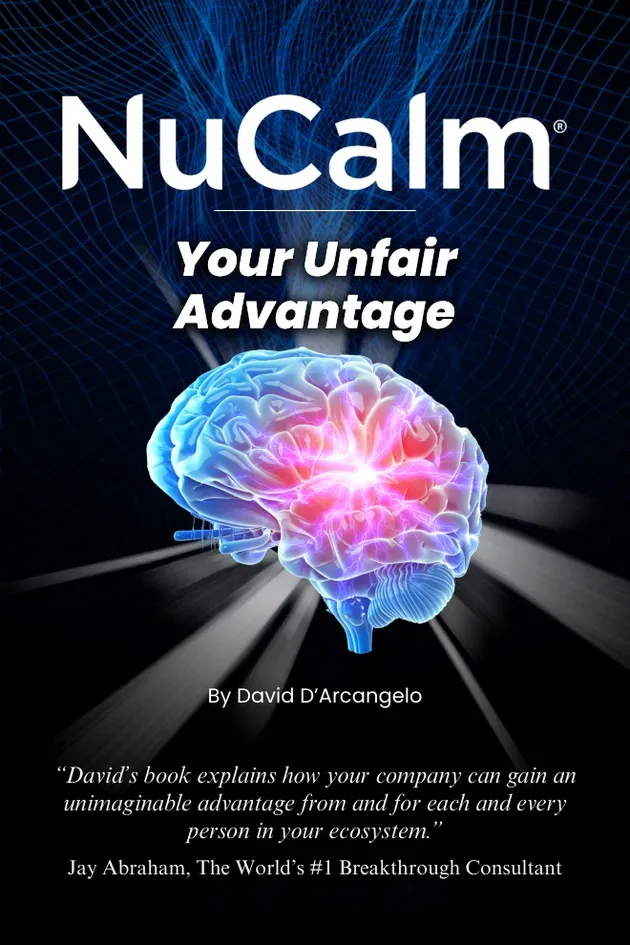
NuCalm: Your Unfair Advantage
A 2025 book by David D'Arcangelo for business leaders about using NuCalm across a whole company, from the neuroscience behind it and the voice-based Stress Assessment to a five-step plan for rolling it out.
- Document
- Book
- Author
- David D'Arcangelo
Key findings
- Ten chapters and two bonus chapters, written for company leaders rather than individual users, with a preface introducing NuCalm CEO Jim Poole.
- Chapter 4 explains the Stress Assessment: 35 seconds of natural speech, analyzed for real-time stress and resilience, returned as a single Coherence Score.
- Chapter 5 is about PowerNap, the 20-minute session the book describes as giving the restoration of two hours of sleep.
- Chapter 9 sets out a five-step rollout, starting with a 30-day pilot in one high-stress department and ending with NuCalm built into onboarding and daily routines.
David D’Arcangelo wrote Your Unfair Advantage in 2025 for people who run companies. He has written several earlier books on business and money, among them Wealth Starts at Home and The Secret Asset. The book is published by Redlands Press. A New Calm tells the story of how NuCalm was invented. This one is about what a business gets when its people use NuCalm every day, and how to bring it in across a whole company.
What follows is a chapter-by-chapter guide. All 104 pages are in the PDF, linked at the top and bottom of this page.
Who the book is for
D’Arcangelo addresses the reader as a leader from the author’s note on: “your people are your performance engine. And your team? It’s every department, every person, every role across your company.” His case is that “the biggest gains don’t just come from strategy, they come from state management,” and that NuCalm “isn’t a wellness perk. It’s a performance protocol.”
The book opens with a page of endorsements from people who use NuCalm, Tony Robbins, Jim Kwik and Ben Greenfield among them, followed by shorter accounts from individual users, organized by product.
What is in the book
Preface: Meet Jim Poole, CEO of NuCalm
A profile of Jim Poole, who has run NuCalm since 2009. It covers his background in healthcare, biotechnology and management consulting, his years at Focused Evolution, the consulting firm he founded before joining NuCalm, and the places he has lectured on the stress response, sleep and recovery. Poole describes the company in his own words: “We have a culture of service. We don’t serve for reciprocity or credit, we serve because we want to, we can, and we love to.”
Chapter 1: Your Company, Upgraded
The opening chapter pictures a Monday morning at a company where everyone uses NuCalm, and then goes role by role: the COO, the head of sales, the support lead and the creative team. It ends with a table comparing morning energy, decision quality, team communication, project delivery and culture without NuCalm and with it.
Chapter 2: The Performance Depletion Economy
D’Arcangelo names the problem the rest of the book answers. Performance depletion, in his words, is “not just stress. It’s not just burnout. It’s a systemic unraveling of the very cognitive and emotional capacity that fuels every decision.” He divides its cost into three tolls, emotional waste, cognitive drag and an energy deficit, and argues that the usual fixes (a new HR platform, a mindfulness lunch and learn, another productivity app) cannot shift brain states in real time.
Chapter 3: The Neuroscience of Performance
The explanatory chapter. It walks through four brain wave states, high beta, mid beta, alpha and theta, and the two branches of the autonomic nervous system, then introduces the products in the app: DeepSleep, Rescue, Focus, PowerNap, Ignite and FlowState. A section on the Rescue session covers the neuroacoustic software, the eye mask or quiet room, and how the shift feels before, during and after.
Chapter 4: The Stress Assessment
The Stress Assessment gets a chapter of its own. It analyzes 35 seconds of natural speech and returns a Coherence Score. The chapter explains why the voice carries this information: “your vagus nerve, the master communicator of your autonomic nervous system, connects directly to your vocal cords.” It sets out what the score ranges mean, how the assessment differs from heart rate variability trackers, step-by-step instructions for taking it, when in the day to use it, and the things that move a score, from sleep deprivation and hard training to travel and hormonal shifts.
Chapter 5: The 2 Hour PowerNap in 20 Minutes
A chapter on PowerNap. D’Arcangelo explains why an ordinary nap often leaves people groggy and why PowerNap is “not a nap” but “precision-engineered recovery.” He lists the changes the book attributes to the session, including lower cortisol and better heart rate variability, and asks the reader to imagine a whole sales force or leadership team taking the same 20 minutes once a day.
Chapter 6: The Stress Loop Is Not Your Fault
Most stress tools, D’Arcangelo argues, work from the top down: they ask the mind to calm the body. NuCalm works from the bottom up, “It doesn’t ask your brain to calm down, it guides it there.” The chapter closes with a passage by Jim Poole on whether the benefits build over time. His answer is yes: “The more you use Rescue, the easier the relaxation response becomes, and so does the depth of healing.”
Chapter 7: How Smart Companies Recover Fast
This chapter is mostly illustrated case studies. One shows the organizations that have used NuCalm, grouped as military and Department of Justice, professional sports, organizations and medical professionals. Another covers the Chicago Blackhawks’ 2013 season, the team’s first full season with NuCalm, and lists its records that year. A third gathers figures on stress and sleep in the general population.
Chapter 8: Why NuCalm Matters to Every Leader, Every Business, and Every Employee
A chapter on the cost of poor sleep and unmanaged stress at work, citing figures the book attributes to the CDC and the National Safety Council. It then sets out what changes for employees and for the company, and recounts NuCalm’s history: 13 years as an FDA Class III medical device for clinicians before it became a consumer app.
Chapter 9: Scaling NuCalm, a Strategic Blueprint for Company-Wide Deployment
The practical chapter, and the one to read for how to roll NuCalm out. It runs in five steps:
- Step 1: launch a 30-day pilot in one high-stress department, such as sales, support or leadership, with clear guidance on which products to use and when
- Step 2: expand department by department, matching products to roles, for example Focus for sales before pitches and Rescue for support staff after hard calls
- Step 3: define and measure what the book calls the invisible ROI, such as faster recovery between meetings and fewer reactive escalations
- Step 4: make it normal, with leadership endorsement, a place in daily routines and a place in onboarding
- Step 5: build a culture where everyone, “from the C-suite to your support team,” can shift mental states when they need to
Chapter 10: The Business Decision That Changes Everything
The closing chapter is a call to act: “Because doing nothing is no longer neutral, it’s expensive.” It ends with a short getting-started section: download the app, choose a product, put on headphones and an eye mask if needed, and press play.
Bonus Chapter I: The Neuroscience of NuCalm
A second, more technical pass at the science. It credits the technology to Dr. G. Blake Holloway and names the four areas of the brain targeted during development: the reticular activating system, the corpus callosum, the HPA axis and the autonomic nervous system. It also explains why the book says the music in a session is not what does the work.
Bonus Chapter II: NuCalm Focus, Your Team’s Cognitive Advantage
A chapter on Focus, which the book says guides the brain into mid-beta, with uses by department: sales, customer support, marketing and creative, and operations. It recommends 20 minutes of Rescue, FlowState or PowerNap before a Focus session, and ends with a map of brain wave states to products, from delta for DeepSleep to gamma for Ignite.
Acknowledgments and next steps
The acknowledgments thank Jim Poole and the NuCalm team and the early adopters whose stories, D’Arcangelo says, inspired the book. A final page sets out next steps for small companies and for organizations of 100 employees or more, with a contact address for the business team.
The book’s note to readers
The book closes with this note, reproduced here as it appears:
Please remember: this publication is intended for informational and educational purposes only. The stories and experiences shared are personal, and individual results may vary. We’ve done our best to present the research and insights with care and integrity. While third-party references are provided in good faith, neither NuCalm nor the author can guarantee their accuracy or be held responsible for outcomes related to their use.
Copyright 2025 by David D’Arcangelo. All rights reserved.